
sales

Selling into education The free pilot that is not a pilot
Business Development, Customer Retention, Sales Enablement, Start-Up

The free pilot that is not a pilot

Selling into education The free pilot that is not a pilot A pilot with no measure, no end date and nobody who can say yes isn’t a trial. It’s a very polite way for everyone to avoid making a decision. By Stella James, Founder, Seventh Sibling There’s a conversation I have with founders selling into education more often than almost any other, and it usually starts with good news. A school is interested. Better than that, they want to try it. So the product goes in for free, for a term or so, and everyone leaves the meeting feeling as though something has happened. Then nothing much does. Nobody wrote down what success would look like. The end date drifts from half-term to “after Christmas” to “let’s pick it up in the spring”. The lovely person who championed it can’t actually sign anything bigger, and the people who can were never in the room. By the time anyone asks how it went, the honest answer is that nobody’s quite sure, and a product that was never properly set up gets judged on a half-hearted few weeks. If you’ve spent any time in this sector, you’ll recognise every line of that. It isn’t a pilot. It’s a parking space with your logo on it. Why everyone says yes to a pilot like this The uncomfortable truth is that the free, open-ended pilot suits both sides, which is exactly why it keeps happening. The supplier gets a foot in the door and something encouraging to put in the pipeline report. The school gets to try something without taking a risk on budget or reputation, and without anyone having to say no to a supplier they quite like. Nobody’s being dishonest. It’s simply comfortable, and comfortable is the enemy of a decision. A school is a busy place, and a pilot that nobody owns will always lose out to the things that somebody does. What it actually costs you Free is never free for the supplier. There’s the onboarding, the training, the support calls and the follow-ups, all given to an account that hasn’t committed to anything. There’s the opportunity cost of the schools you didn’t have time for because this one felt so close. And then there’s the quieter damage. A pilot that drifts never gives you a clear no, so it sits in your forecast looking far healthier than it is. You can’t learn from it, because nothing was measured. Worst of all, your product gets its reputation in that school from a trial that was never set up to show what it can do. A pilot that drifts never gives you a clear no, so it sits in your forecast looking far healthier than it is. What a real pilot looks like when you’re selling into education Schools don’t mind pilots at all, and nor should you. What a pilot needs is a reason to make a decision at the end of it, and that reason has to be agreed at the start, while everybody’s still excited. Before anything goes in, get these on paper. What you’re measuring, and how. Agree it with the school, in their language, tied to something they already care about. If you can’t describe what good looks like at the end, neither of you will recognise it when it arrives. The date it ends. A real date, in the diary, with a review meeting booked before the pilot starts. Not “the end of term-ish”. The person who makes the call. By name. Ideally they’re at the kick-off and the review, and they’ve agreed what they’ll need to see to say yes. What happens if it works. This is the one most people skip. Talk about the contract that follows before the pilot begins: roughly what it would cover, when it would start and where the budget would come from. It feels bold, and schools tend to respect it, because it shows you’re taking their decision as seriously as they are. Free or paid? This is where I’ll get a few raised eyebrows. In my experience, the moment a school puts something in, even something modest, the whole pilot is taken more seriously on both sides. Somebody has had to approve it, which means somebody is now interested in whether it worked. A paid pilot, kept short and properly managed, is very often a better pilot. That doesn’t mean free is always wrong. It means free should be a deliberate choice you’ve made for a good reason, rather than the thing that happens by default because nobody wanted to have the money conversation. When the school won’t agree Sometimes you’ll ask for those things and the school will hesitate. They can’t name the decision-maker, or they don’t want to commit to a date, or the conversation about what comes next goes very quiet. That’s not a failure. That’s the most useful information you’ll get all term. If nobody will agree to those things, they were never buying. They were browsing, and that’s fine, as long as you know. You can still help them. You might suggest a smaller first step, or tell them honestly that now isn’t the moment and you’ll come back when it is. “Not yet” is a perfectly good answer when you’re selling into education, and it’s a lot kinder to your forecast, your team and your product than a pilot that quietly fades away by the third week. So here’s my challenge. If you’ve got a pilot running right now, check it against that list. If it’s missing one, fix it this week while there’s still time. If it’s missing all four, you already know the answer, and it’s better to hear it now than in the spring. Pilots that drift? Let’s talk. Seventh Sibling works with British education technology companies on the commercial side of the business, from how you run a pilot to how you turn one into a contract. Get in touch About Stella James Stella is the
Selling into education: the 15 minutes that lost the deal
Sales Enablement

Selling into education: the fifteen minutes that lost the deal

Sales Enablement Selling into Education: the Fifteen Minutes That Lost the Deal I went looking for this one. I asked to be sold to, I turned up wanting to buy, and he still managed to lose me before the coffee had gone cold. SJ Stella James · 21 September 2026 · 5 min read I was on the wrong end of a sales call this week. Wrong end, because I was the buyer, and because I was the one who went looking for it in the first place. Somebody recommended the company to me. I had a look at what they do, thought there might be something in it for us, and I reached out. So the man on the other end of that call had a warm buyer on a plate, asking to be sold to, having already decided she was interested enough to give up half an hour of a Tuesday. First thing he said was that he’d had a look at us and reckoned he’d got the gist. He hadn’t got the gist. The only thing he actually knew about me was that I work in education, which is roughly as useful as knowing that somebody lives in Europe. Then he talked. For fifteen minutes. I stopped him in the end, which I don’t love doing, and said look, I’m sorry, but everything you’re describing I’m already doing. And I was a bit cross about it, because one question would have told him that, and instead he spent a quarter of an hour selling me my own life back. He had a warm buyer, on a plate, asking to be sold to. He lost me in fifteen minutes, and he’ll probably write it up as a budget problem. Where the pitch actually belongs Most people are taught to hold the pitch as a thing. A separate object, rehearsed, with a beginning and an end, that gets deployed once the pleasantries are out of the way. Discovery becomes the bit you get through so you can start. Here’s the bit that keeps getting missed. The pitch is supposed to run alongside the questions and get built out of what they tell you. Done properly, the whole thing doesn’t feel like a sales call at all. It feels like a conversation, which is, rather, the point. That matters everywhere, and it matters more when you’re selling into education, because the word “school” hides an enormous amount. A head of a single primary with a hundred and eighty children on roll and a central team running twenty-eight academies have almost nothing in common as buyers. Different money, different timelines, different people who can say yes, different reasons to care. A pitch built before the call can’t possibly be right for both, so it gets written for neither. You get about five minutes Five minutes at the start to make somebody want to keep talking to you. That’s the whole budget. Spend it describing your product and you’ve spent it, and everything after that is a polite person waiting for a gap. They won’t tell you. Nobody in education tells a supplier they lost them at minute six. They say it’s interesting, they say they’ll take it to the team, they ask you to send something over, and then the something over sits in an inbox next to four hundred other somethings over. You log it as a maybe. It was a no, and it became a no while you were still talking. What research actually means Research is the least glamorous part of the job, which is exactly why it gets skipped, and everyone skips it in the same way: a quick look at the website, a scroll of somebody’s profile, done. That isn’t research. That’s reassurance. Before you get on the call, you want honest answers to five things. What kind of organisation is this really, and who holds the money. What have they already bought that does some of what you do, because something will. What have they said in public about this year’s priorities, which is usually sitting in a development plan, a newsletter or a governors’ document that nobody outside the school ever reads. Who is on the call, and what does their year look like from where they’re sitting. And finally, the one thing you genuinely don’t know and want to ask them, out loud, early. Job adverts are the honest ones, incidentally. A school will tell a careers page what it’s struggling with far more plainly than it will ever tell a supplier. If you haven’t done the research before you call, you’ve already spent the five minutes. The genuinely hard bit None of this is difficult to understand. It’s difficult to do, and it’s difficult for one very human reason: you can feel the pitch in your mouth. They say something that connects to slide four and everything in you wants to get to slide four. Holding that, asking a second question instead, letting them finish a sentence you could have finished for them, is the actual skill. It’s also the thing no amount of product training gives you. I’ve spent a lot of this year listening to recorded calls while training teams, and the pattern is always earlier than people expect. Not the objection handling. Not the close. The first five minutes, and what was or wasn’t done the night before. The course for the five minutes before the pitch Four steps, all of them boringly practical: strategic discovery, concept introduction, collaborative exploration, solution alignment. Built for sales and business development teams working with schools, trusts and colleges. Education Market Sales Mastery is £497, or £422.45 for BESA members. Would rather talk it through? Book a call. Which brings me back to my man and his fifteen minutes. He had the thing the rest of the sector would take an arm for. Inbound. A buyer who reached out, who wanted to be sold to, who had already talked herself into the

Blog post title: Are You Building a Pipeline or Just a Wish List? by Stella James, Seventh Sibling
Sales Enablement, Start-Up

Are you building a pipeline or just a wish list

Are You Building a Pipeline or Just a Wish List? | Seventh Sibling Sales Enablement Are You Building a Pipeline or Just a Wish List? Stella James  ·  1 May 2026  ·  6 min read I want you to open your CRM. Or your spreadsheet. Or whatever you’re using to track your sales pipeline. Now look at it honestly. Not optimistically. Not with the rose-tinted glasses you put on before a board meeting. Honestly. How many of those “opportunities” have had a meaningful conversation in the last thirty days? How many of them actually know they’re in your pipeline? How many have a real budget, a real decision-maker, and a genuine reason to move before the end of term? If the answer makes you slightly uncomfortable, you’re not alone. And you’re not failing. You’ve just built a wish list and called it a pipeline. Almost everyone does it. What a wish list looks like A wish list is a collection of schools and MATs that you’d like to work with. They might have shown a flicker of interest at a conference. They might have downloaded something from your website six months ago. They might just be a name you know. A wish list feels productive. It grows. You can point to it. It looks like momentum. But it isn’t moving. It’s just sitting there, making you feel better than you should. “A pipeline isn’t a list of people who haven’t said no yet. It’s a list of people who have actively said yes to the next step.” That’s the only real distinction. And it cuts most CRMs in half. Why this happens in education sales specifically Education buyers are polite. That’s the trap. A school business manager will sit through your demo, nod, ask good questions, and say “that’s really interesting — leave it with me.” And you’ll walk away thinking: that went well. They’re interested. They might be. Or they might be too kind to tell you they haven’t got the budget, their Head isn’t buying in, and they’ve got four other vendors saying the same thing. Politeness in education isn’t a buying signal. It’s just politeness. The sector runs on it. So if you’re measuring pipeline health by whether people are being nice to you in meetings, you’re measuring the wrong thing entirely. The five questions that separate pipeline from wish list For every opportunity in your CRM, ask these five questions. Be brutal. Pipeline Qualification Test Have I spoken to the actual decision-maker — not just a champion? Do they have a confirmed budget for this, or are we still at “exploring options”? Is there a specific problem they’ve told me they need to solve, in their words? Have they agreed to a next step with a specific date in both our diaries? Do I know what success looks like to them — not to me? If you can’t answer yes to at least three of those, it’s not in your pipeline. Move it to a nurture list and stop counting it as revenue. That will hurt. Briefly. Then it’ll feel like clarity. If they won’t put it in the diary, there’s your answer This one is so simple it shouldn’t need saying. And yet. You have a great conversation. They’re nodding. They say “yes, let’s pick this up next week.” You say “brilliant, I’ll drop you a calendar invite.” Radio silence. That’s not a busy person. That’s a polite no. When someone is genuinely interested, they find ten minutes to confirm a meeting. When they’re not, they don’t. How hard someone works to get time in the diary with you is one of the most reliable indicators of how serious they actually are. I’ve never seen a deal close where the buyer consistently cancelled, ghosted, or “got back to you next week” for months on end. The agreed next step with a confirmed date isn’t admin. It’s a commitment. And if they won’t make it, you need to know that now — not in six months when you’ve spent your entire Q3 chasing someone who was never really in. Get the right stakeholders in the room early Here’s the other way deals die quietly in education. You’ve built a great relationship with one person — usually the person who found you, liked you, and genuinely wants what you’re offering. And you’ve been selling to them for three months. Then it gets to the point where something needs to happen, and suddenly there are four other people involved. A finance director who’s never heard of you. A CEO who has a preferred supplier list. A Head of School who doesn’t see why this is a priority. Your champion is helpless. And the deal stalls — or dies. MAT deals especially are multi-stakeholder by nature. The person you’re talking to almost never has unilateral sign-off. So your job, from very early in the process, is to understand who else needs to be part of the conversation — and start building those relationships before the pressure is on. Not when the contract is on the table. Now. Ask your champion directly: “Who else is going to need to be involved when we get to the point of making a decision?” Then ask to meet them. The sooner you’re known to the full decision-making group, the fewer ambushes at the end. Activity isn’t progress Here’s the other thing I see constantly. Teams who are busy as anything — sending emails, attending events, doing demos, following up — but whose pipeline hasn’t actually moved in months. Activity and progress are not the same thing. Sending a follow-up email that gets no reply and calling it “nurturing” is activity. Getting a reply that commits to a meeting next Tuesday is progress. The difference matters enormously when you’re trying to hit targets in a sector with a nine-month buying cycle and a budget window that slams shut in March. Every single interaction you have with a prospect should be moving them toward

The UK education sales calendar mapped by month showing when to sell to schools and MATs
Business Development, Sales Enablement, Start-Up

The Seasonality of Education Sales

The Seasonality of Education Sales (And How to Plan Around It) | Seventh Sibling Business Development The Seasonality of Education Sales(And How to Plan Around It) Stella James  ·  24 April 2026  ·  6 min read Education has a calendar. Most people selling into it don’t. And that’s why most pipelines look the way they do. The teams that consistently win in education aren’t better at selling. They’re better at timing. They know when the doors are open, when they’re firmly shut, and — crucially — when everyone else has given up and the real conversations are just getting started. Here’s the thing nobody tells you when you start selling into schools and MATs: you only get 41 weeks of genuine selling time in the UK education system. The rest is noise, closed doors, and chasing people who simply aren’t in the right headspace to buy. 41 weeks of genuine selling time in UK education Use them wisely — or watch your competitors do it instead. First: Know Who You’re Selling To This matters before anything else — because schools and MATs don’t run on the same calendar. Schools typically operate on an April financial year. Budgets reset in April. Decisions get made in the spring term. If you want to close a school deal, your groundwork needs to be done well before Easter. MATs are more likely to run a September financial year. That changes everything. The MAT sales cycle starts in September, gets serious in January, and closes in April. Same sector. Completely different buying rhythm. If you’re treating schools and MATs the same, you’re already working against yourself. The Real Education Sales Calendar Schools MATs Both Schools + MATs September MAT year opens. Schools settle in. For MATs, this is the start of the financial year — fresh budgets, new priorities, conversations can begin. For schools, budgets are already set. Brilliant for relationship building. Not closing. Schools + MATs October – November The sweet spot nobody uses. The most underrated window in the calendar. The chaos of September has settled. Budget holders are thinking about what hasn’t worked. Leaders have headspace again. Discover. Don’t pitch. Schools + MATs December Everyone shuts up shop. Don’t fight it. Use the time to plan, review your pipeline, and prepare for what comes next. MATs January Dead for schools. Critical for MATs. January is one of the hardest months if you’re selling to schools. Nobody is buying. But for MATs — if you started conversations in September — January is when deals get serious. Proposals, evaluations, proper discussions. Schools February – March Schools start to move. For schools on an April financial year, budget decisions are being shaped right now. Relationships built since October start to pay off here. If you haven’t been in conversation since autumn, you’re late. Schools + MATs April MATs close. School budgets open. Two things at once. MAT deals progressing since September close here. Schools enter a new financial year — fresh budgets and final decisions. April is one of the most important months in the calendar. Schools May – June Plant seeds, not pressure. Schools are exhausted. Assessments, reports, leavers. Nobody wants to be sold to. But they will talk. Ask what worked, what didn’t, what they wish they’d done differently. Walk into September with a head start nobody else has. Schools + MATs August Don’t write it off. Everyone says August is dead. I’ve closed some of my biggest deals in August. Leaders are out of the day-to-day. They have thinking time. They’re planning for September. A well-timed, low-pressure message can open a door that stays shut all year. The Mistake Most Teams Make They build their pipeline around their own targets, not the buyer’s calendar. They push hard in January because that’s when their year starts. They panic in March because the numbers need to be there. They go quiet in August because they assume nobody’s around. None of that maps to how schools and MATs actually buy. The teams that consistently win in education don’t work harder at the wrong moments. They work smarter at the right ones. Planting in summer, building in autumn, closing in spring — and doing it in that order, every year, without fail. The 41-week reality. Factor in school holidays, INSET days, exam periods, and the weeks where nobody answers the phone — and you’re left with roughly 41 weeks of genuine selling time. Every week you waste pushing at a closed door is a week you could have spent building something that opens one. One Practical Thing You Can Do This Week Look at your pipeline. For every deal that’s stalled or gone quiet — what time of year did you start that conversation? And are you pushing at a moment that maps to your buyer’s calendar, or yours? Now look at the deals that closed. When did those relationships actually begin? There’s almost always a pattern. And once you see it, you can’t unsee it. 41 weeks. Use them wisely. I’m going deeper on education sales strategy in B2Education Unpacked — the podcast for everyone selling into schools, MATs and colleges. Launching 6 May 2026. Join the waitlist Stella James Founder, Seventh Sibling · B2Education

for accessibility — describe what's in the image): Dark navy featured image with the text "Objection Handling in Education: It's Not What You Think" in white and coral, with Stella James and Seventh Sibling credited at the bottom
Business Development

Objection Handling in Education

Objection Handling in Education: It’s Not What You Think | Seventh Sibling Sales Enablement Objection Handling in Education:It’s Not What You Think Stella James  ·  17 April 2026  ·  5 min read “We don’t have the budget.” That’s not an objection. That’s information. And there’s a difference. I’ve been selling into education for over a decade. And the number one mistake I see — from brilliant people selling genuinely useful things — is treating a signal like a wall. Someone pushes back and the instinct is to push back harder. Counter the objection. Overcome the resistance. Close the gap. But that’s not how education works. And if you’re selling into schools, MATs or colleges, you already know that. The question is whether your sales approach knows it too. Why Education Is Different The people you’re selling to are not sitting in an office waiting for your call. They’re running schools. Managing trusts. Stretching budgets that were never big enough. They’re accountable to governors, parents, Ofsted, and about forty-seven other things before they get to you. When they push back, it’s almost never a no. It’s almost always a not yet, a not like this, or — and this is the one most people miss — help me understand why this is worth fighting for internally. The buyer who says “now isn’t a great time” isn’t dismissing you. They’re telling you something about their world. Your job is to listen to it. The Five You’ll Hear Most — and What They Actually Mean “We don’t have the budget.” What it usually means Budget exists somewhere. It’s just not allocated here, not yet, or not by this person. Try asking: Where does spending like this typically come from? Is there a budget cycle coming up? Who owns decisions about where discretionary spend goes? Budget in education rarely doesn’t exist. It moves. Your job is to understand where it lives and when it’s available — not to argue that you’re worth it. “We’re already using something similar.” What it usually means They have something. Whether it’s working is a completely different question. Try asking: How’s that going? What does it do well? Is there anything it doesn’t do that you wish it did? Resist the urge to immediately explain why you’re better. Get curious first. Half the time, the existing solution isn’t actually doing what they need — they just haven’t had headspace to look at alternatives. “Now isn’t a good time.” What it usually means One of three things: genuinely overloaded, not the right person and being polite, or the value hasn’t landed clearly enough to justify their attention right now. Try asking: Completely understand — when would be better? And in the meantime, is there anyone else I should speak to? Never just accept it and disappear. That’s not respecting their time. That’s giving up and hoping they’ll come back to you. They won’t. “We need to speak to the rest of the team.” What it usually means Good sign. They’re interested enough to involve others. Now your job is to make that internal conversation as easy as possible for them. Try asking: Who else needs to be involved? What are their likely concerns? Can I put something together that helps you take this to them? Don’t wait and hope. Equip the person in front of you to become your internal champion. “We’ve had a bad experience before.” What it usually means They were oversold to, underserved, or left to sink post-sale with no support. This is not an objection to you. It’s a wound. Try asking: I’m really sorry to hear that. What happened? What would have made it different? This is the one most people handle worst — because it triggers defensiveness. We’re not like that. Our onboarding is completely different. Don’t. Just listen. Ask the question and actually hear the answer. The Actual Shift Objection handling in education isn’t about having the right answer. It’s about asking the right question. The people who consistently win in this market — whether they’re selling software, services, training, resources, or anything else — are not the ones with the sharpest rebuttals. They’re the ones who make the buyer feel heard. Who respond to resistance with curiosity rather than pressure. Who understand that not yet is not the same as no. Slow down. Get curious. Talk less. That is genuinely it. Try This Take the last three deals that went quiet. Write down the exact words the buyer used when they pushed back. Now ask yourself honestly: did I treat that as an objection to overcome, or information to explore? If the answer is overcome — go back. Not necessarily to reopen the deal, but to ask one question. “I’ve been thinking about our last conversation. I wonder if I missed something. Would you be open to a quick call?” You’ll be surprised how often that works. I’m going deeper on education sales conversations in B2Education Unpacked — the podcast for everyone selling into schools, MATs and colleges. Launching 6 May 2026. Join the waitlist Stella James Founder, Seventh Sibling · B2Education

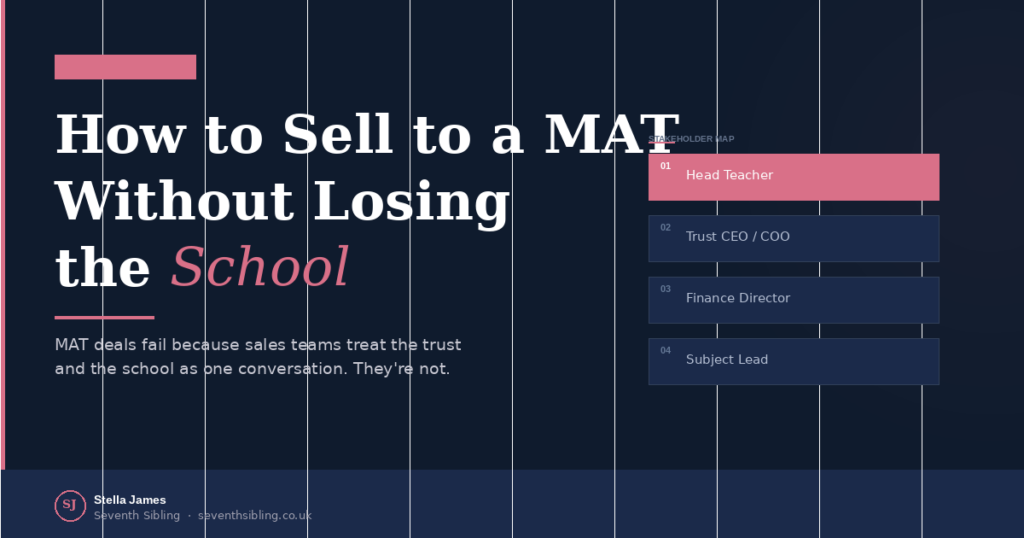
Stakeholder map showing the four key decision makers in a MAT EdTech sale — head teacher, trust CEO, finance director, and subject lead
Business Development, Sales Enablement, Start-Up

How to Sell to a MAT Without Losing the School

How to Sell to a MAT Without Losing the School | Seventh Sibling Seventh Sibling ← All Posts Sales Enablement 10 April 2026 How to Sell to a MAT Without Losing the School Multi-academy trusts have changed everything about how EdTech gets bought in England. A lot of sales teams still haven’t caught up. SJ Stella James Founder, Seventh Sibling · 5 min read I see it constantly. A well-run discovery call with a head teacher. Good rapport. Real need identified. The head is genuinely interested. Then it goes to trust level for sign-off and quietly dies. Six weeks later you find out they went with someone else. What went wrong? Usually one of three things. Sometimes all three at once. You sold to the school and ignored the MAT A head teacher’s enthusiasm is real. It’s also limited. In a MAT structure, purchasing decisions above a certain threshold — and most EdTech products clear it — go up the chain. Finance director. COO. Sometimes the CEO. If your entire relationship is with the school and you’ve got no line of sight into trust level, you’re building on sand. The head becomes your advocate, which is valuable, but they’re not the decision maker. You’ve won the room and lost the deal. You sold to the MAT and the school felt steamrolled The opposite problem. You got smart, went straight to the top, secured a trust-wide agreement. Excellent. Except nobody told the schools properly, the head teacher feels bypassed, and your implementation is already fighting an uphill battle before it starts. EdTech doesn’t fail at the sale. It fails at the renewal. And renewals live or die on whether the people using the product every day actually wanted it. You didn’t map the stakeholders at all In any MAT deal there are at least four different types of concern you need to address. Same product. Four completely different conversations. Head Teacher Impact in their school, their pupils, their staff workload. Trust CEO / COO Consistency across schools, strategic fit, and whether this creates more problems than it solves. Finance Director Value, contract terms, and what happens if it doesn’t work. Curriculum / Subject Lead Whether it actually works in a classroom. If you’re running one pitch and hoping it lands for everyone, it won’t. What to do instead Map it early. In your first discovery call, ask directly — how does purchasing work here? Who else would need to be involved in a decision like this? Who would be most affected by getting this right? Most buyers will tell you. They’re not trying to hide the org chart. They just won’t volunteer it unless you ask. Then treat the school relationship and the trust relationship as separate threads that need to be managed in parallel. Different conversations, different concerns, different cadences. The head teacher needs to feel heard. The trust needs to feel confident. Those are not the same thing and they don’t happen in the same meeting. The EdTech companies I’ve seen crack MAT sales consistently are the ones who understand they’re not selling a product into a school. They’re selling a solution into a system. Systems have layers. Work the layers. It takes longer. It closes more reliably. And it renews. Stella James is the founder of Seventh Sibling, a B2B EdTech sales consultancy helping EdTech companies sell into UK schools, MATs, and colleges. She’s also the host of B2Education Unpacked — The Education Growth Podcast, launching May 2026. Coming May 2026 B2Education Unpacked The Education Growth Podcast The podcast for people selling into education. Real conversations. No fluff. Join the waitlist and be first to know when it drops. Join the Waitlist In This Post Selling to the school, ignoring the MAT Selling to the MAT, losing the school Not mapping stakeholders at all What to do instead Seventh Sibling Home Blog Podcast Con

Dark navy editorial graphic with a minimalist line-art illustration of an ear and a speech bubble dissolving mid-air, in hot pink and teal. Text reads: How to Run a Discovery Call That Actually Discovers Something. Seventh Sibling Consulting.
Sales Enablement

How to Run a Discovery Call That Actually Discovers Something

How to Run a Discovery Call That Actually Discovers Something | Seventh Sibling Sales Enablement · 13 March 2026 · 5 min read SJ Stella James Seventh Sibling Consulting · B2Education Unpacked How to Run a Discovery Call That Actually Discovers Something We’ve been taught to ask the right questions. Nobody taught us to actually listen to the answers. And the person on the other end of your call knows it. Here’s a thing that happens on almost every EdTech discovery call. The salesperson asks: “So what are the biggest challenges you’re facing this year?” The school leader answers. Honestly, usually. They talk about workload. About the pressure they’re under. About the thing that didn’t work last time and why they’re cautious now. They give you something real. And then the salesperson picks it apart. Not intentionally. Not unkindly. But they’ve already heard enough to know which feature to pivot to, and they’re off — slotting what they’ve just been told into a pre-existing narrative about why their product is the answer. The actual human experience being described? Gone. Processed into a sales cue and discarded. The school leader notices. They always notice. And the next time someone asks them that question — maybe the very next vendor call, maybe yours — they give a shorter answer. A safer one. The real challenges stay where they’ve learned they belong: unsaid. We’ve forgotten that the person on the other end of the call is a human being, not a brief. They’ve heard it all before. That’s the problem. School leaders and MAT executives are not naive buyers. They’ve been on the receiving end of more EdTech pitches than they can count. They know the format. They know the questions that are really just warm-up acts for the demo. They know when they’re being listened to and when they’re being processed. And because they know all of this, they’ve built a version of themselves for supplier calls. Polite. Reasonably engaged. Vague enough to avoid saying anything that will trigger forty minutes of product features they didn’t ask for. That version isn’t the person you need to be talking to. It’s the armour they put on because nobody gave them a reason to take it off. The question “what are your biggest challenges this year?” has been asked so many times, in so many calls, as a precursor to the same pivot, that it has stopped meaning anything. It’s a ritual. Both sides know their lines. What happens next — the part nobody talks about — is that you end up building your entire pitch on information that was never quite true. You think you understand their situation. You don’t. You understood the edited version they felt safe to share with a stranger who was clearly already halfway to the demo in their head. What it actually feels like to be on the other end I want you to sit with this for a moment. You’re a head of a secondary school. It’s Tuesday morning. You’ve got a budget that doesn’t stretch, a staffing problem you’re managing hour by hour, and an Ofsted visit that’s been hovering on the horizon for two terms. You’ve agreed to a thirty-minute call with an EdTech company because something in their email was just relevant enough. They ask how you are. You say fine. They ask about challenges. You mention workload — the honest, universal, bone-deep exhaustion of it. And before you’ve finished the sentence, they’re nodding with slightly too much enthusiasm and saying “yes, that’s exactly what our platform addresses.” They didn’t hear what you said. They heard a keyword that mapped to a feature. How does that feel? Not catastrophic. Not offensive, exactly. Just… deflating. Like talking to someone who’s waiting for their turn to speak. And you think, not for the first time: I don’t know why I bother being honest in these calls. It doesn’t change anything. That moment — that quiet, unremarkable decision to stop being honest — is where your deal dies. Not in the follow-up. Not in the proposal. Right there, in the gap between what they said and what you heard. Genuine curiosity about another person’s situation is one of the rarest things in a sales call. It is also one of the most disarming. The shift is smaller than you think I’m not asking you to become a therapist. I’m asking you to be genuinely curious. When someone tells you they’re struggling with workload, don’t reach for the feature. Ask what that actually looks like for them. Which part of the job is heaviest right now? What did last term feel like? What would have to change for next term to feel different? Let them get to the end of a thought before you respond. Not as a technique — as basic human respect. They’re telling you something real. Receive it. Ask how things affect them personally, not just institutionally. “How does that land for you?” is a question almost no salesperson asks. It’s also the question that opens every door worth opening. The information you get from a conversation where someone feels genuinely heard is completely different from the information you get from a processed discovery call. It’s more specific, more honest, and far more useful. And the relationship that conversation builds — the sense that this person actually got it — is worth more than any demo you could run. What you’re actually selling EdTech buyers aren’t buying software. They know that. You know that. They’re buying a little more breathing room in an impossible job. They’re buying the confidence that they’ve made a good decision with a tight budget. They’re buying the feeling that someone understood what they were dealing with and offered them something that actually fit. You can’t sell any of that if you don’t know what their life actually looks like. And you can’t know what their life looks like if you’re too busy mapping their answers onto your pitch to

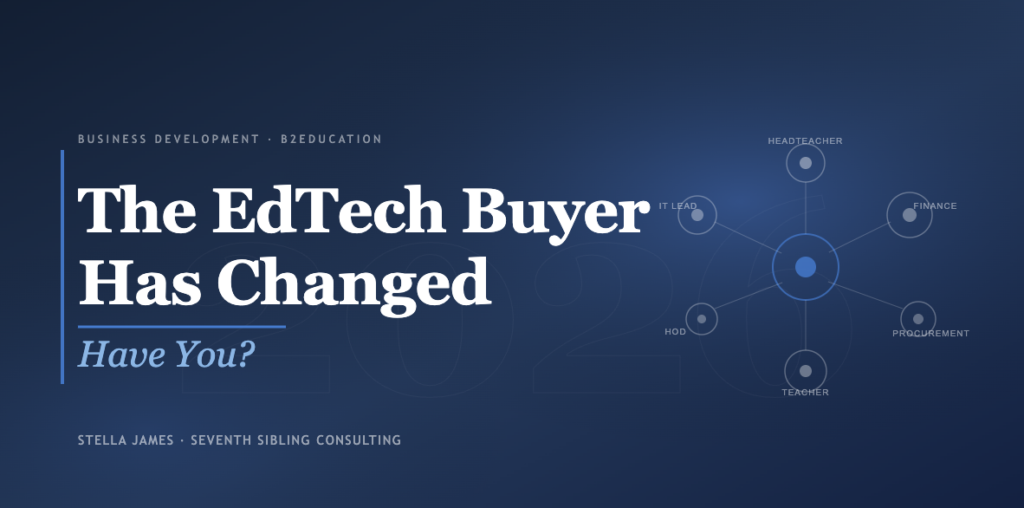
A network diagram showing the multiple stakeholders involved in an EdTech purchasing decision — headteacher, finance, procurement, teacher, head of department, and IT lead — all connected to a central node, against a dark navy background with the headline: The EdTech Buyer Has Changed — Have You?
Business Development

The EdTech Buyer Has Changed

The EdTech Buyer Has Changed — Have You? | B2Education B2Education · Business Development · 6 March 2026 Business Development 6 March 2026 5 min read The EdTech Buyer Has Changed — Have You? The way schools make purchasing decisions has shifted in almost every dimension. Here is what that means for your sales approach in 2026. SJ Stella James Seventh Sibling Consulting · B2Education Unpacked Ten years ago, selling into schools was relatively straightforward. You found the person with the budget, showed them the product, answered a few questions, and closed the deal. One person, one decision, one conversation. That model is gone. The EdTech buyer has changed in almost every dimension — who they are, how they decide, what they care about, and how much time they have. The question is whether your sales approach has changed with them. The buyer has changed. The question is whether your approach has. The decision is no longer one person’s to make Walk into a MAT deal today and you are not selling to one person. You are selling to a committee that may not know it is a committee yet. There is the headteacher or principal who cares about outcomes and reputation. There is the class teacher or head of department who will actually use the product and wants to know whether it will create more work or less. There is the finance lead who is managing stretched budgets and wants to know the total cost of ownership, not just the licence fee. And there is procurement, who may have requirements your sales team has never even asked about. Sell to one and ignore the others and your deal stalls. Every time. Not because the product is wrong, but because the person you sold to cannot carry the decision on their own. They have less time and more options than ever before The average school leader is managing more complexity than at any point in the last two decades. Curriculum pressures, staffing challenges, tightening budgets, increased accountability. EdTech is not at the top of their list. It is competing with everything else. At the same time, the market is more crowded than it has ever been. Your buyer has seen more supplier pitches, received more cold emails, and sat through more demos than they can count. They have also made buying mistakes they are not eager to repeat. This combination — less time, more options, higher caution — means the old approach of leading with features and following up with a demo simply does not work anymore. They are not buying software. They are buying a solution to a problem they are not sure you understand yet. They are buying outcomes, not products This is the shift that changes everything. The modern EdTech buyer does not want to hear about your platform’s functionality in the first ten minutes of a conversation. They want to know whether you understand their situation. Whether you have worked with schools like theirs. Whether you can articulate the problem they are trying to solve more clearly than they can. Features are easy to list. Every competitor has a features page. What is genuinely rare is a salesperson who asks the right questions, listens to the answers, and connects what they have heard to an outcome the buyer already cares about. That shift — from product-led to outcome-led — is not just a technique. It is a fundamental reorientation of what the sales conversation is for. What this means for your sales approach If your process has not evolved alongside the buyer, you will feel it in stalled pipelines, long decision cycles, and deals that die in committee without explanation. Here are the three shifts that matter most: Lead with questions, not answers. Your first job is to understand the situation, not to present a solution. The discovery call should discover something. Map the stakeholders before you present. Know who cares about what before you get everyone in a room. Teachers, heads, finance, and procurement all have different concerns. Address them separately before you address them together. Sell the outcome, not the feature. When you do present, frame everything in terms of what it changes for the school — not what it does as a product. The good news The buyers who are harder to sell to are also the buyers who are more loyal once you have earned their trust. Schools do not switch suppliers lightly. If you get the relationship right — if you understand their situation and deliver on what you have said — you have a customer who renews, expands, and refers. The challenge is that earning that trust requires a different kind of selling. Less presenting, more listening. Less feature-walking, more problem-exploring. Less chasing the deal, more building the case. The EdTech buyer has changed. The sales approach that wins in 2026 looks very different from the one that worked in 2016. If you are still using the old playbook, it is worth asking: what needs to change? If you want to go deeper on how to adapt your sales approach for the modern EdTech buyer — from discovery through to stakeholder management — that is exactly what I am building B2Education Unpacked to explore. More on that in May. Tagged EdTech Sales School Decision-Making MAT Procurement Business Development EdTech 2026 SJ Stella James Founder of Seventh Sibling Consulting and host of B2Education Unpacked. Twelve years working in and around EdTech sales, helping teams sell more effectively into schools and trusts.

Build a complete, education-specific commercial engine – from positioning and pricing to discovery, concept-led business development, stakeholder navigation and measurement. This is the full playbook for EdTech founders and commercial leaders who want sustainable growth in education markets. You’ll learn how to: Position your product for schools, MATs and education organisations Design an education-specific business development strategy Run strategic discovery and concept-led conversations Navigate complex stakeholder groups and decision-making in education Measure what matters and build a pipeline that actually converts Best for: EdTech founders, CEOs and commercial leaders who want an end-
Business Development

Announcing CPD Accreditation for B2Education Mastery: Elevating EdTech Sales Training

Big news: B2Education Mastery: The Complete EdTech Business Development Guide is now CPD accredited (January 2026). If you’ve ever tried selling into schools or MATs and thought, “Why is this so hard?”, you’re not imagining it. Education isn’t just B2B with nicer people. It’s complex, high-stakes, and full of stakeholders who all care about different things — and rightly so. This accreditation matters because it’s an independent mark that the course meets recognised CPD standards and delivers practical learning you can actually apply. Why CPD Accreditation Matters Continuing Professional Development (CPD) accreditation is a trusted mark of quality and relevance. It assures learners and organisations that the training meets rigorous standards and delivers practical, applicable knowledge. For EdTech companies, sales is often the most overlooked skill. Many teams assume sales is a natural talent rather than a professional discipline. Our course challenges that misconception by providing sector-specific training tailored to the unique challenges and stakeholders in education. Sign up today Why CPD Accreditation matters (especially for sales) Sales capability is often the most overlooked part of an EdTech business. Too many teams assume sales is a personality trait — something you either have or you don’t. In reality, sales is a professional skill. In education, it’s a specialist one. When it’s done well, it builds trust, sets expectations properly, and makes implementation smoother. When it’s done badly… customer success ends up with the mop and bucket. What you’ll learn in B2Education Mastery This is a self-paced online course built specifically for selling into education. Inside you’ll get: 15 comprehensive lessons covering concept selling, stakeholder mapping, procurement navigation, and more. Practical frameworks and downloadable toolkits designed specifically for the education sector. Self-paced online delivery with engaging AI-generated video lessons. Embedded quizzes and assessments to reinforce learning. CPD certification that learners can showcase to demonstrate their professional growth. Who it’s for EdTech founders, commercial leads, sales teams, and anyone who’s been “volunteered” into selling in education and wants a repeatable, ethical way to do it. Ready to get started? If you want to build a proper education-specific commercial engine — without the fluff — you can enrol here: Enrol to B2Education Mastery

Professional illustration showing two business professionals in meaningful conversation, depicting active listening and genuine engagement in a sales meeting, using Seventh Sibling brand colours of deep green, light blue, cream and soft pink
Business Development, Customer Retention, Sales Enablement, Start-Up

The Power of Active Listening: Why Slowing Down Builds Stronger EdTech Relationships

You’re ten minutes into a discovery call. You’ve got your agenda ready, questions prepared, and a clear plan to move the conversation forward.
But your prospect is chatting away—about their school, their challenges, their weekend, their team dynamics. You can feel the clock ticking. Your instinct is to gently steer them back on track.

Scroll to Top
EdTech Founders Growth Playbook

EdTech Founders Growth Playbook