
Business Development

Transform your EdTech sales approach from transactional to strategic. Discover proven frameworks and methodologies that delivered £2.2M in profit transformation. Expert insights on relationship building, solution selling, and long-term growth strategies in education technology.

Why your case studies aren't converting — sales enablement blog by Seventh Sibling"
Business Development, Sales Enablement

Why Your Case Studies Aren’t Converting

Why Your Case Studies Aren’t Converting (And How to Fix Them) | Seventh Sibling Sales Enablement Why Your Case Studies Aren’t Converting (And How to Fix Them) Stella James  |  May 2026  |  6 min read You’ve got the case study. The school said nice things. Marketing made it look beautiful. It’s on the website. It’s in the pitch deck. And it’s doing absolutely nothing. I see this constantly. Companies selling into education with five, ten, sometimes twenty case studies — and none of them are moving deals forward. They exist because someone somewhere decided “we need case studies” and ticked the box. But nobody stopped to ask what the case study was actually supposed to do. Here’s the uncomfortable truth: most case studies in education sales are testimonials wearing a longer jacket. And testimonials don’t close deals. The wrong person problem The biggest mistake I see is case studies written for the person who already said yes. Think about it. You go back to the school that loves you. You ask them to say how great you are. They do — because they are lovely people and they genuinely like your product. You write it up, add a photo of some happy children, and put it on the website. Who is that for? It’s not for the head teacher at the school down the road who has never heard of you. It’s not for the MAT finance lead who needs to justify spending. It’s not for the procurement officer comparing you against three other providers. It’s for you. It makes you feel good. And it sits on a page that nobody who matters is reading. This is a stakeholder mapping problem. If you’ve done your homework on a deal — if you know who the decision makers are, who the influencers are, who holds the budget and who holds the veto — then you already know that a single case study cannot speak to all of them at once. The head teacher needs to see classroom impact. The finance lead needs to see value. The trust CEO needs to see strategic alignment. Send the same document to all three and you’ve impressed none of them. A case study that converts is written for a specific person who hasn’t bought yet. It speaks to their problem, not your product. It shows someone in their role dealing with something they recognise. That’s a completely different document from the one most companies are producing. The timing problem Case studies get sent at the wrong moment. Usually too early. Someone has had one conversation with you. They’re vaguely interested. You send them three case studies, a one-pager, and a link to a webinar recording. Congratulations — you’ve just made their inbox feel like homework. A case study lands when the buyer is past curiosity and into justification. They already think what you’re offering might work. Now they need evidence to take to someone else. That’s the moment. Not before. If you’re sending case studies before a second conversation, you’re not selling — you’re hoping. And hope is not a strategy. A case study that converts names a problem the reader already has, shows measurable impact from someone like them, and makes the next step obvious. What most case studies actually say I’ve read hundreds of these. Most of them follow the same structure: here’s the school, here’s what they bought, here’s how much they liked it. Three paragraphs of context nobody asked for, a couple of quotes that could apply to any product in any sector, and a call to action that says “book a demo.” None of that is useful to the person reading it. They don’t care about the school’s name. They care about whether the school had the same problem they have. They don’t care that the head teacher said something nice. They care about impact. What actually changed? For whom? By how much? The most common line I see in education case studies is some version of “it’s been a game changer for our school.” That tells me nothing. What changed? Over what time period? What does the data say? If you can’t answer those questions, you don’t have a case study. You have a review. And reviews don’t give a deputy head what they need to go to their head teacher and say “we should buy this.” What a converting case study actually does Three things. That’s it. First, it names a problem the reader recognises. Not your version of the problem — theirs. “This school was struggling with teacher workload during assessment periods” is better than “this school wanted to improve their assessment process.” One is something a deputy head has actually said out loud in a meeting. The other is marketing language. And if you’ve done your stakeholder mapping properly, you already know which problems keep which people awake at night. Second, it shows measurable impact. Not “teachers loved it.” Not “it transformed our approach.” What specifically changed, for whom, and by how much. If attendance improved, say by what percentage. If teacher time was saved, say how many hours. If outcomes shifted, show the data. Impact is the thing that lets the person reading your case study walk into their next internal meeting and make the case for you when you’re not in the room. Without it, they’ve got nothing to say except “it looked good in the demo.” Third, it makes the next step obvious. And the next step is almost never “book a demo.” The next step is whatever removes the biggest remaining barrier for that specific stakeholder. For the head teacher, it might be a conversation with the school in the case study. For the finance lead, it might be a pricing conversation. For the trust board, it might be a pilot proposal. Make it concrete, make it easy, and make it relevant to where the reader actually is in their decision. The MAT problem If you’re selling into multi-academy trusts,

The UK education sales calendar mapped by month showing when to sell to schools and MATs
Business Development, Sales Enablement, Start-Up

The Seasonality of Education Sales

The Seasonality of Education Sales (And How to Plan Around It) | Seventh Sibling Business Development The Seasonality of Education Sales(And How to Plan Around It) Stella James  ·  24 April 2026  ·  6 min read Education has a calendar. Most people selling into it don’t. And that’s why most pipelines look the way they do. The teams that consistently win in education aren’t better at selling. They’re better at timing. They know when the doors are open, when they’re firmly shut, and — crucially — when everyone else has given up and the real conversations are just getting started. Here’s the thing nobody tells you when you start selling into schools and MATs: you only get 41 weeks of genuine selling time in the UK education system. The rest is noise, closed doors, and chasing people who simply aren’t in the right headspace to buy. 41 weeks of genuine selling time in UK education Use them wisely — or watch your competitors do it instead. First: Know Who You’re Selling To This matters before anything else — because schools and MATs don’t run on the same calendar. Schools typically operate on an April financial year. Budgets reset in April. Decisions get made in the spring term. If you want to close a school deal, your groundwork needs to be done well before Easter. MATs are more likely to run a September financial year. That changes everything. The MAT sales cycle starts in September, gets serious in January, and closes in April. Same sector. Completely different buying rhythm. If you’re treating schools and MATs the same, you’re already working against yourself. The Real Education Sales Calendar Schools MATs Both Schools + MATs September MAT year opens. Schools settle in. For MATs, this is the start of the financial year — fresh budgets, new priorities, conversations can begin. For schools, budgets are already set. Brilliant for relationship building. Not closing. Schools + MATs October – November The sweet spot nobody uses. The most underrated window in the calendar. The chaos of September has settled. Budget holders are thinking about what hasn’t worked. Leaders have headspace again. Discover. Don’t pitch. Schools + MATs December Everyone shuts up shop. Don’t fight it. Use the time to plan, review your pipeline, and prepare for what comes next. MATs January Dead for schools. Critical for MATs. January is one of the hardest months if you’re selling to schools. Nobody is buying. But for MATs — if you started conversations in September — January is when deals get serious. Proposals, evaluations, proper discussions. Schools February – March Schools start to move. For schools on an April financial year, budget decisions are being shaped right now. Relationships built since October start to pay off here. If you haven’t been in conversation since autumn, you’re late. Schools + MATs April MATs close. School budgets open. Two things at once. MAT deals progressing since September close here. Schools enter a new financial year — fresh budgets and final decisions. April is one of the most important months in the calendar. Schools May – June Plant seeds, not pressure. Schools are exhausted. Assessments, reports, leavers. Nobody wants to be sold to. But they will talk. Ask what worked, what didn’t, what they wish they’d done differently. Walk into September with a head start nobody else has. Schools + MATs August Don’t write it off. Everyone says August is dead. I’ve closed some of my biggest deals in August. Leaders are out of the day-to-day. They have thinking time. They’re planning for September. A well-timed, low-pressure message can open a door that stays shut all year. The Mistake Most Teams Make They build their pipeline around their own targets, not the buyer’s calendar. They push hard in January because that’s when their year starts. They panic in March because the numbers need to be there. They go quiet in August because they assume nobody’s around. None of that maps to how schools and MATs actually buy. The teams that consistently win in education don’t work harder at the wrong moments. They work smarter at the right ones. Planting in summer, building in autumn, closing in spring — and doing it in that order, every year, without fail. The 41-week reality. Factor in school holidays, INSET days, exam periods, and the weeks where nobody answers the phone — and you’re left with roughly 41 weeks of genuine selling time. Every week you waste pushing at a closed door is a week you could have spent building something that opens one. One Practical Thing You Can Do This Week Look at your pipeline. For every deal that’s stalled or gone quiet — what time of year did you start that conversation? And are you pushing at a moment that maps to your buyer’s calendar, or yours? Now look at the deals that closed. When did those relationships actually begin? There’s almost always a pattern. And once you see it, you can’t unsee it. 41 weeks. Use them wisely. I’m going deeper on education sales strategy in B2Education Unpacked — the podcast for everyone selling into schools, MATs and colleges. Launching 6 May 2026. Join the waitlist Stella James Founder, Seventh Sibling · B2Education

for accessibility — describe what's in the image): Dark navy featured image with the text "Objection Handling in Education: It's Not What You Think" in white and coral, with Stella James and Seventh Sibling credited at the bottom
Business Development

Objection Handling in Education

Objection Handling in Education: It’s Not What You Think | Seventh Sibling Sales Enablement Objection Handling in Education:It’s Not What You Think Stella James  ·  17 April 2026  ·  5 min read “We don’t have the budget.” That’s not an objection. That’s information. And there’s a difference. I’ve been selling into education for over a decade. And the number one mistake I see — from brilliant people selling genuinely useful things — is treating a signal like a wall. Someone pushes back and the instinct is to push back harder. Counter the objection. Overcome the resistance. Close the gap. But that’s not how education works. And if you’re selling into schools, MATs or colleges, you already know that. The question is whether your sales approach knows it too. Why Education Is Different The people you’re selling to are not sitting in an office waiting for your call. They’re running schools. Managing trusts. Stretching budgets that were never big enough. They’re accountable to governors, parents, Ofsted, and about forty-seven other things before they get to you. When they push back, it’s almost never a no. It’s almost always a not yet, a not like this, or — and this is the one most people miss — help me understand why this is worth fighting for internally. The buyer who says “now isn’t a great time” isn’t dismissing you. They’re telling you something about their world. Your job is to listen to it. The Five You’ll Hear Most — and What They Actually Mean “We don’t have the budget.” What it usually means Budget exists somewhere. It’s just not allocated here, not yet, or not by this person. Try asking: Where does spending like this typically come from? Is there a budget cycle coming up? Who owns decisions about where discretionary spend goes? Budget in education rarely doesn’t exist. It moves. Your job is to understand where it lives and when it’s available — not to argue that you’re worth it. “We’re already using something similar.” What it usually means They have something. Whether it’s working is a completely different question. Try asking: How’s that going? What does it do well? Is there anything it doesn’t do that you wish it did? Resist the urge to immediately explain why you’re better. Get curious first. Half the time, the existing solution isn’t actually doing what they need — they just haven’t had headspace to look at alternatives. “Now isn’t a good time.” What it usually means One of three things: genuinely overloaded, not the right person and being polite, or the value hasn’t landed clearly enough to justify their attention right now. Try asking: Completely understand — when would be better? And in the meantime, is there anyone else I should speak to? Never just accept it and disappear. That’s not respecting their time. That’s giving up and hoping they’ll come back to you. They won’t. “We need to speak to the rest of the team.” What it usually means Good sign. They’re interested enough to involve others. Now your job is to make that internal conversation as easy as possible for them. Try asking: Who else needs to be involved? What are their likely concerns? Can I put something together that helps you take this to them? Don’t wait and hope. Equip the person in front of you to become your internal champion. “We’ve had a bad experience before.” What it usually means They were oversold to, underserved, or left to sink post-sale with no support. This is not an objection to you. It’s a wound. Try asking: I’m really sorry to hear that. What happened? What would have made it different? This is the one most people handle worst — because it triggers defensiveness. We’re not like that. Our onboarding is completely different. Don’t. Just listen. Ask the question and actually hear the answer. The Actual Shift Objection handling in education isn’t about having the right answer. It’s about asking the right question. The people who consistently win in this market — whether they’re selling software, services, training, resources, or anything else — are not the ones with the sharpest rebuttals. They’re the ones who make the buyer feel heard. Who respond to resistance with curiosity rather than pressure. Who understand that not yet is not the same as no. Slow down. Get curious. Talk less. That is genuinely it. Try This Take the last three deals that went quiet. Write down the exact words the buyer used when they pushed back. Now ask yourself honestly: did I treat that as an objection to overcome, or information to explore? If the answer is overcome — go back. Not necessarily to reopen the deal, but to ask one question. “I’ve been thinking about our last conversation. I wonder if I missed something. Would you be open to a quick call?” You’ll be surprised how often that works. I’m going deeper on education sales conversations in B2Education Unpacked — the podcast for everyone selling into schools, MATs and colleges. Launching 6 May 2026. Join the waitlist Stella James Founder, Seventh Sibling · B2Education

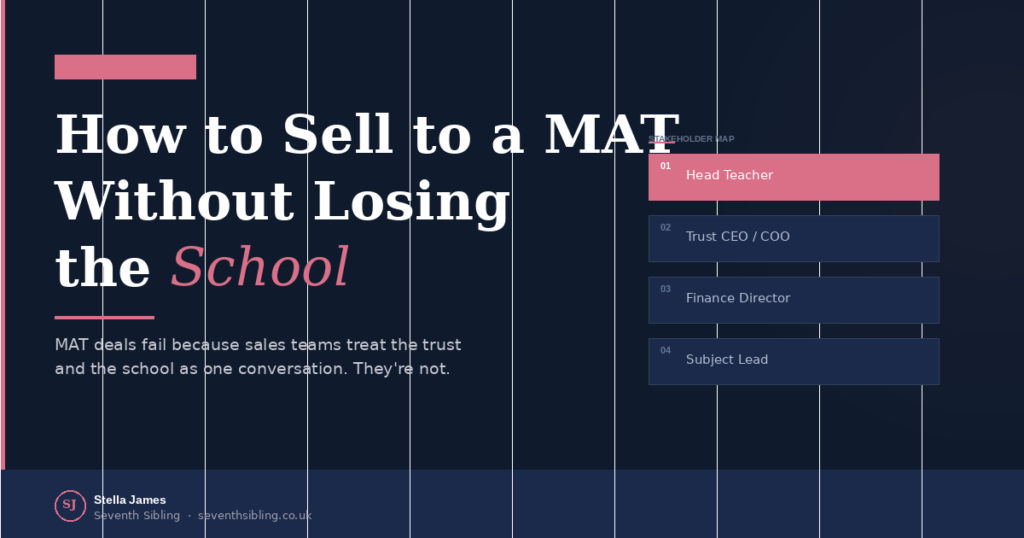
Stakeholder map showing the four key decision makers in a MAT EdTech sale — head teacher, trust CEO, finance director, and subject lead
Business Development, Sales Enablement, Start-Up

How to Sell to a MAT Without Losing the School

How to Sell to a MAT Without Losing the School | Seventh Sibling Seventh Sibling ← All Posts Sales Enablement 10 April 2026 How to Sell to a MAT Without Losing the School Multi-academy trusts have changed everything about how EdTech gets bought in England. A lot of sales teams still haven’t caught up. SJ Stella James Founder, Seventh Sibling · 5 min read I see it constantly. A well-run discovery call with a head teacher. Good rapport. Real need identified. The head is genuinely interested. Then it goes to trust level for sign-off and quietly dies. Six weeks later you find out they went with someone else. What went wrong? Usually one of three things. Sometimes all three at once. You sold to the school and ignored the MAT A head teacher’s enthusiasm is real. It’s also limited. In a MAT structure, purchasing decisions above a certain threshold — and most EdTech products clear it — go up the chain. Finance director. COO. Sometimes the CEO. If your entire relationship is with the school and you’ve got no line of sight into trust level, you’re building on sand. The head becomes your advocate, which is valuable, but they’re not the decision maker. You’ve won the room and lost the deal. You sold to the MAT and the school felt steamrolled The opposite problem. You got smart, went straight to the top, secured a trust-wide agreement. Excellent. Except nobody told the schools properly, the head teacher feels bypassed, and your implementation is already fighting an uphill battle before it starts. EdTech doesn’t fail at the sale. It fails at the renewal. And renewals live or die on whether the people using the product every day actually wanted it. You didn’t map the stakeholders at all In any MAT deal there are at least four different types of concern you need to address. Same product. Four completely different conversations. Head Teacher Impact in their school, their pupils, their staff workload. Trust CEO / COO Consistency across schools, strategic fit, and whether this creates more problems than it solves. Finance Director Value, contract terms, and what happens if it doesn’t work. Curriculum / Subject Lead Whether it actually works in a classroom. If you’re running one pitch and hoping it lands for everyone, it won’t. What to do instead Map it early. In your first discovery call, ask directly — how does purchasing work here? Who else would need to be involved in a decision like this? Who would be most affected by getting this right? Most buyers will tell you. They’re not trying to hide the org chart. They just won’t volunteer it unless you ask. Then treat the school relationship and the trust relationship as separate threads that need to be managed in parallel. Different conversations, different concerns, different cadences. The head teacher needs to feel heard. The trust needs to feel confident. Those are not the same thing and they don’t happen in the same meeting. The EdTech companies I’ve seen crack MAT sales consistently are the ones who understand they’re not selling a product into a school. They’re selling a solution into a system. Systems have layers. Work the layers. It takes longer. It closes more reliably. And it renews. Stella James is the founder of Seventh Sibling, a B2B EdTech sales consultancy helping EdTech companies sell into UK schools, MATs, and colleges. She’s also the host of B2Education Unpacked — The Education Growth Podcast, launching May 2026. Coming May 2026 B2Education Unpacked The Education Growth Podcast The podcast for people selling into education. Real conversations. No fluff. Join the waitlist and be first to know when it drops. Join the Waitlist In This Post Selling to the school, ignoring the MAT Selling to the MAT, losing the school Not mapping stakeholders at all What to do instead Seventh Sibling Home Blog Podcast Con

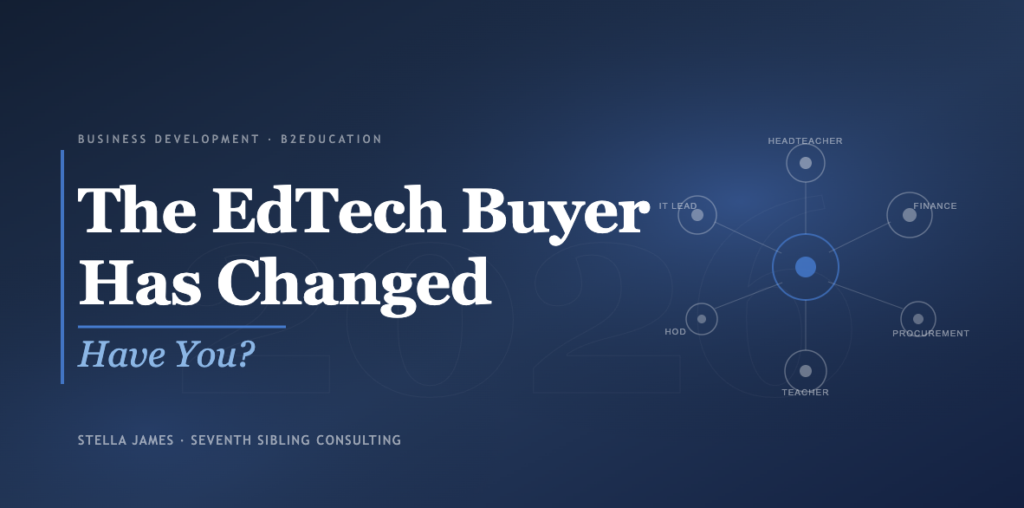
A network diagram showing the multiple stakeholders involved in an EdTech purchasing decision — headteacher, finance, procurement, teacher, head of department, and IT lead — all connected to a central node, against a dark navy background with the headline: The EdTech Buyer Has Changed — Have You?
Business Development

The EdTech Buyer Has Changed

The EdTech Buyer Has Changed — Have You? | B2Education B2Education · Business Development · 6 March 2026 Business Development 6 March 2026 5 min read The EdTech Buyer Has Changed — Have You? The way schools make purchasing decisions has shifted in almost every dimension. Here is what that means for your sales approach in 2026. SJ Stella James Seventh Sibling Consulting · B2Education Unpacked Ten years ago, selling into schools was relatively straightforward. You found the person with the budget, showed them the product, answered a few questions, and closed the deal. One person, one decision, one conversation. That model is gone. The EdTech buyer has changed in almost every dimension — who they are, how they decide, what they care about, and how much time they have. The question is whether your sales approach has changed with them. The buyer has changed. The question is whether your approach has. The decision is no longer one person’s to make Walk into a MAT deal today and you are not selling to one person. You are selling to a committee that may not know it is a committee yet. There is the headteacher or principal who cares about outcomes and reputation. There is the class teacher or head of department who will actually use the product and wants to know whether it will create more work or less. There is the finance lead who is managing stretched budgets and wants to know the total cost of ownership, not just the licence fee. And there is procurement, who may have requirements your sales team has never even asked about. Sell to one and ignore the others and your deal stalls. Every time. Not because the product is wrong, but because the person you sold to cannot carry the decision on their own. They have less time and more options than ever before The average school leader is managing more complexity than at any point in the last two decades. Curriculum pressures, staffing challenges, tightening budgets, increased accountability. EdTech is not at the top of their list. It is competing with everything else. At the same time, the market is more crowded than it has ever been. Your buyer has seen more supplier pitches, received more cold emails, and sat through more demos than they can count. They have also made buying mistakes they are not eager to repeat. This combination — less time, more options, higher caution — means the old approach of leading with features and following up with a demo simply does not work anymore. They are not buying software. They are buying a solution to a problem they are not sure you understand yet. They are buying outcomes, not products This is the shift that changes everything. The modern EdTech buyer does not want to hear about your platform’s functionality in the first ten minutes of a conversation. They want to know whether you understand their situation. Whether you have worked with schools like theirs. Whether you can articulate the problem they are trying to solve more clearly than they can. Features are easy to list. Every competitor has a features page. What is genuinely rare is a salesperson who asks the right questions, listens to the answers, and connects what they have heard to an outcome the buyer already cares about. That shift — from product-led to outcome-led — is not just a technique. It is a fundamental reorientation of what the sales conversation is for. What this means for your sales approach If your process has not evolved alongside the buyer, you will feel it in stalled pipelines, long decision cycles, and deals that die in committee without explanation. Here are the three shifts that matter most: Lead with questions, not answers. Your first job is to understand the situation, not to present a solution. The discovery call should discover something. Map the stakeholders before you present. Know who cares about what before you get everyone in a room. Teachers, heads, finance, and procurement all have different concerns. Address them separately before you address them together. Sell the outcome, not the feature. When you do present, frame everything in terms of what it changes for the school — not what it does as a product. The good news The buyers who are harder to sell to are also the buyers who are more loyal once you have earned their trust. Schools do not switch suppliers lightly. If you get the relationship right — if you understand their situation and deliver on what you have said — you have a customer who renews, expands, and refers. The challenge is that earning that trust requires a different kind of selling. Less presenting, more listening. Less feature-walking, more problem-exploring. Less chasing the deal, more building the case. The EdTech buyer has changed. The sales approach that wins in 2026 looks very different from the one that worked in 2016. If you are still using the old playbook, it is worth asking: what needs to change? If you want to go deeper on how to adapt your sales approach for the modern EdTech buyer — from discovery through to stakeholder management — that is exactly what I am building B2Education Unpacked to explore. More on that in May. Tagged EdTech Sales School Decision-Making MAT Procurement Business Development EdTech 2026 SJ Stella James Founder of Seventh Sibling Consulting and host of B2Education Unpacked. Twelve years working in and around EdTech sales, helping teams sell more effectively into schools and trusts.

Dark navy graphic with the text 'The Mirror You Never Look Into' in white and coral, featuring an abstract circular mirror motif and the Seventh Sibling branding. Blog feature image for a post about sales training and self-reflection when selling into education.
Business Development, Sales Enablement

The Mirror You Never Look Into

Most salespeople have never once listened back to their own calls. They’d sooner lose the deal — and blame the budget — than confront what they actually sound like. This is the long-form companion to our #TheMirrorYouNeverUse social campaign: on why selling into education demands more than charm, more than volume, and considerably more self-awareness than most of us are currently bringing to the table.

Build a complete, education-specific commercial engine – from positioning and pricing to discovery, concept-led business development, stakeholder navigation and measurement. This is the full playbook for EdTech founders and commercial leaders who want sustainable growth in education markets. You’ll learn how to: Position your product for schools, MATs and education organisations Design an education-specific business development strategy Run strategic discovery and concept-led conversations Navigate complex stakeholder groups and decision-making in education Measure what matters and build a pipeline that actually converts Best for: EdTech founders, CEOs and commercial leaders who want an end-
Business Development

Announcing CPD Accreditation for B2Education Mastery: Elevating EdTech Sales Training

Big news: B2Education Mastery: The Complete EdTech Business Development Guide is now CPD accredited (January 2026). If you’ve ever tried selling into schools or MATs and thought, “Why is this so hard?”, you’re not imagining it. Education isn’t just B2B with nicer people. It’s complex, high-stakes, and full of stakeholders who all care about different things — and rightly so. This accreditation matters because it’s an independent mark that the course meets recognised CPD standards and delivers practical learning you can actually apply. Why CPD Accreditation Matters Continuing Professional Development (CPD) accreditation is a trusted mark of quality and relevance. It assures learners and organisations that the training meets rigorous standards and delivers practical, applicable knowledge. For EdTech companies, sales is often the most overlooked skill. Many teams assume sales is a natural talent rather than a professional discipline. Our course challenges that misconception by providing sector-specific training tailored to the unique challenges and stakeholders in education. Sign up today Why CPD Accreditation matters (especially for sales) Sales capability is often the most overlooked part of an EdTech business. Too many teams assume sales is a personality trait — something you either have or you don’t. In reality, sales is a professional skill. In education, it’s a specialist one. When it’s done well, it builds trust, sets expectations properly, and makes implementation smoother. When it’s done badly… customer success ends up with the mop and bucket. What you’ll learn in B2Education Mastery This is a self-paced online course built specifically for selling into education. Inside you’ll get: 15 comprehensive lessons covering concept selling, stakeholder mapping, procurement navigation, and more. Practical frameworks and downloadable toolkits designed specifically for the education sector. Self-paced online delivery with engaging AI-generated video lessons. Embedded quizzes and assessments to reinforce learning. CPD certification that learners can showcase to demonstrate their professional growth. Who it’s for EdTech founders, commercial leads, sales teams, and anyone who’s been “volunteered” into selling in education and wants a repeatable, ethical way to do it. Ready to get started? If you want to build a proper education-specific commercial engine — without the fluff — you can enrol here: Enrol to B2Education Mastery

Professional illustration showing two business professionals in meaningful conversation, depicting active listening and genuine engagement in a sales meeting, using Seventh Sibling brand colours of deep green, light blue, cream and soft pink
Business Development, Customer Retention, Sales Enablement, Start-Up

The Power of Active Listening: Why Slowing Down Builds Stronger EdTech Relationships

You’re ten minutes into a discovery call. You’ve got your agenda ready, questions prepared, and a clear plan to move the conversation forward.
But your prospect is chatting away—about their school, their challenges, their weekend, their team dynamics. You can feel the clock ticking. Your instinct is to gently steer them back on track.

Professional business graphic showing money on a table with text overlay reading "Why Your EdTech Pricing Is Leaving Money on the Table" in brand colours of deep green, light blue, cream and soft pink
Business Development, Customer Retention, Sales Enablement, Start-Up

Why Your EdTech Pricing Is Leaving Money on the Table

You’ve spent months building your product. You’ve validated the problem. Schools love your solution. But when it comes to pricing, you’ve done what most EdTech founders do: You looked at competitors, undercut them by 20%, and hoped that would win deals. It won’t. Competing on price is a race to the bottom that you can’t win. There’s always someone willing to charge less, deliver less, and go out of business faster. It’s time to stop guessing and start pricing strategically. The Pricing Mistakes EdTech Founders Make Mistake 1: Cost-Plus PricingYou calculate your costs, add a margin, and call that your price. This ignores the value you create. A solution that saves schools £50,000 annually shouldn’t be priced based on your £10,000 development cost. Mistake 2: Competitor-Based PricingYou match or undercut competitors without understanding why they charge what they do. Their pricing might be wrong. Or they might be targeting different customers with different value propositions. Mistake 3: One-Size-Fits-All PricingYou charge the same price regardless of school size, usage, or value received. A 2,000-pupil secondary school gets the same value as a 200-pupil primary? Unlikely. Mistake 4: Underpricing to “Get Traction”You think low prices will accelerate adoption. They won’t. They’ll attract price-sensitive customers who churn quickly and devalue your solution in the market. The Value-Based Pricing Framework Price based on the value you create, not your costs or competitors’ prices. Here’s how: Step 1: Quantify the Value You CreateWhat measurable outcomes does your solution deliver? Time saved? Cost reduced? Revenue increased? Student outcomes improved? Put numbers to these outcomes. Example: If your solution saves teachers 5 hours per week and the school has 30 teachers, that’s 150 hours weekly or 5,400 hours annually. At £30/hour, that’s £162,000 in value. Step 2: Identify Your Value MetricWhat drives value for customers? Number of pupils? Number of teachers? Usage volume? Choose a metric that aligns with the value received. As they get more value, they pay more. Step 3: Create Pricing TiersSegment customers by size, needs, or value received. Offer good/better/best options. Most customers choose the middle tier, but having a premium option anchors perceived value higher. Step 4: Test and OptimisePricing isn’t set in stone. Test different price points with new customers. Track win rates, deal size, and customer feedback. Adjust based on data, not gut feel. The Pricing Conversation How you present pricing matters as much as the price itself: Lead with Value, Not PriceEstablish value before discussing price. “Based on your 40 teachers, you’ll save approximately 200 hours per week. That’s £6,000 in reclaimed time per week. Our annual fee is £15,000.” Anchor HighPresent your premium option first. This makes your standard pricing seem more reasonable. “Our enterprise package is £50,000 annually and includes… Our standard package at £25,000 includes…” Frame Annually, Not MonthlyEducation budgets are annual. Present annual pricing first, then break it down: “£12,000 annually, which works out to £1,000 per month or £33 per day.” Bundle ValueDon’t itemise every feature. Bundle related capabilities into packages with clear value propositions. “Our Growth package includes everything you need to improve literacy outcomes across Key Stage 2.” When to Increase Prices Most EdTech companies wait too long to raise prices. Increase prices when: Grandfather existing customers for 12 months, then migrate them to new pricing. Most will accept it if you’ve delivered value. The Pricing Tiers That Work Structure your tiers to drive customers toward your target package: Starter (Entry Point)Limited features, smaller schools, lower price. This gets customers in the door but encourages upgrade as they see value. Professional (Target Package)Full features, most customers, optimal price point. This is where you want most customers to land. Price it for profitability. Enterprise (Premium)Unlimited usage, dedicated support, custom features. This anchors value high and serves your largest customers profitably. Make the Professional tier obviously a better value than the Starter. Most customers will choose it. Handling Price Objections When prospects say “That’s too expensive,” they’re really saying one of three things: “I don’t see the value” → Re-establish value. Quantify outcomes. Share case studies.“I don’t have a budget” → Explore budget cycles, alternative funding sources, or phased implementation.“I can get it cheaper elsewhere” → Differentiate on value, not price. If they’re comparing on price alone, you haven’t established unique value. Never discount without getting something in return: longer contract, case study participation, referrals, or faster payment terms. Stop Competing on Price, Start Capturing Value Your pricing communicates your value. Price is too low, and schools assume your solution isn’t as good as the competitors’. Price is based on value, and you attract customers who care about outcomes, not just cost. The goal isn’t to be the cheapest—it’s to be the obvious choice for schools that value what you deliver. Ready to develop a pricing strategy that captures the value you create? Join the free EdTech Founder’s Growth Playbook course for the complete Pricing Strategy Framework, including value quantification templates, pricing tier structures, and objection handling scripts. Enrol now for free: EdTech Play Book Because in EdTech, your pricing strategy determines your profitability—and your positioning. About the Author: Stella is the founder of Seventh Sibling and has over 20 years of experience in EdTech sales, business development, and leadership. She’s helped EdTech companies achieve £2.2m profit turnarounds, 41% YoY revenue growth, and has won six innovation awards for her work in the education sector.

Scroll to Top
EdTech Founders Growth Playbook

EdTech Founders Growth Playbook