
Selling into education
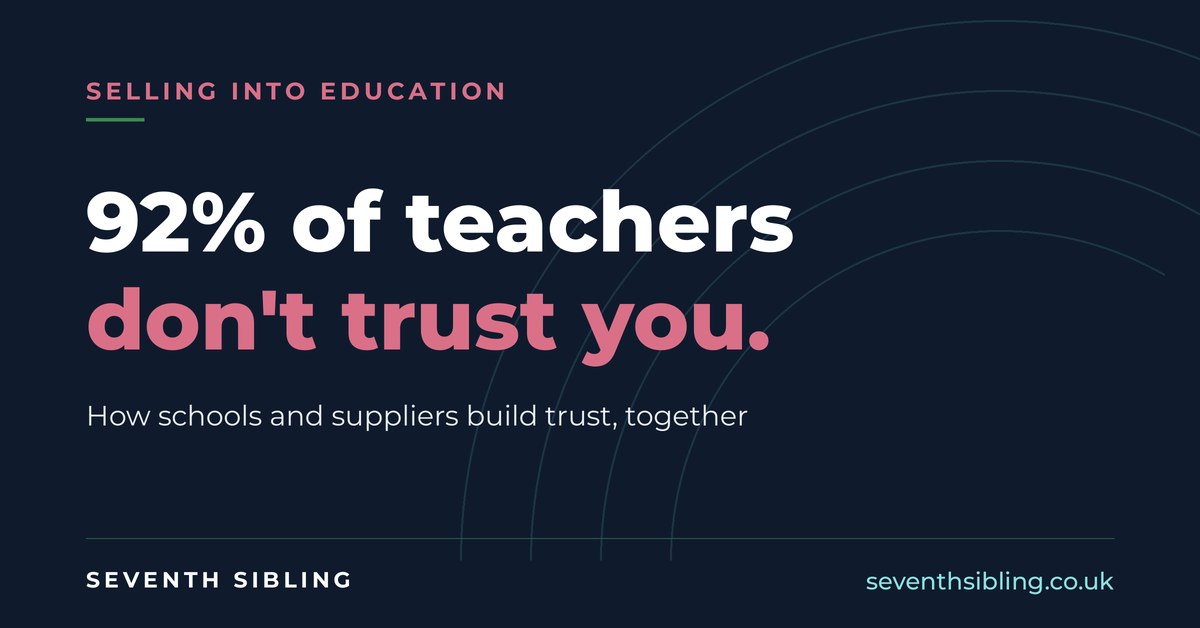
Ninety-two per cent of teachers don’t trust you. Shall we talk about that?
I sat on a panel in Birmingham last week and one number has been following me around ever since. It’s not a comfortable one, and I think it’s the most useful thing anyone said all week.
Last week I was at the Schools & Academies Show in Birmingham, sitting on a panel with Caroline Wright, Michael Forshaw, Kristy Evers and Dave Smith. Lovely people, a properly good conversation, and a lot of coffee drunk out of very small cups.
But the thing I came home with was a number. 92% of teachers don’t trust education technology suppliers.
Read that again, slowly, the way I did on the train. Not “have reservations”. Not “would like a bit more evidence”. Don’t trust. Nine out of every ten.
If you sell into schools, that’s your starting position. Before you’ve said hello, before the lovely demo, before you’ve even found the right person’s email address, you’re already carrying that. It isn’t personal, and it isn’t fair on you, but it’s there, and pretending it isn’t is the quickest way to prove it right.
Where it comes from
I’d love to tell you it’s all a misunderstanding. It isn’t. Schools have been burned, and they remember.
They remember the product that was going to save everyone four hours a week and quietly added two. They remember the “free” trial that turned into an invoice. They remember the account manager who was lovely until the contract was signed and then seemed to have emigrated. And they remember being sold a transformation when what they needed was something that worked on a Monday morning with thirty children and a dodgy wifi signal.
Nobody has to have been dishonest for trust to go. It’s usually a pile of small, tired disappointments, and every supplier that comes after inherits the lot.
So what do you actually do about it?
Not a rebrand, and certainly not another strapline with the word “partnership” in it. Trust is built in very ordinary, slightly dull ways, and the good news is that nearly all of them are within your control.
Ask first, and then actually listen. Most trust is lost in the first few minutes of a conversation, and it’s lost by talking. Ask what’s going on in their school or trust this year. Ask what they’ve tried. Then let them finish the sentence, even when you know how it ends. If you want the long version of this, I wrote about it in the fifteen minutes that lost the deal.
Learn how schools actually buy. Budgets are set on a cycle you didn’t choose. Procurement has rules, thresholds and frameworks, and the person who loves your product probably can’t sign for it. Someone in a trust may be looking after twenty-odd schools’ spending at once. If you turn up knowing this, you’re instantly easier to work with. If you don’t, you’re another thing to explain.
Say what it can’t do. This is the big one, and it feels completely counterintuitive. The supplier who says “honestly, that’s not what we’re best at” is the one the school believes about everything else. Overpromising wins you a meeting and loses you a renewal. Under-promise, over-deliver, and be a bit boring about it.
Talk about the money after the contract, too. Training, set-up, extra licences, the time staff will need. Put it on the table early, in plain English. Nobody likes a surprise in year two, and a school will remember who didn’t give them one. I went into this in more detail in what a school needs you to fund after the contract is signed.
Turn up after the sale. Implementation is where trust is won or lost for good. A named person, a proper check-in, training that includes the new starters in January and not just the people in the room in September. If you sold it, making it work is partly your job.
Let schools talk to other schools. References do more than any case study with a nice photo on it. Offer the contact before you’re asked, and make sure it’s a school that will tell the truth. If you’re nervous about that, it’s worth finding out why.
Be useful before you sell. Share something that helps, with nothing attached. A straight answer to a question, an introduction, a bit of knowledge you happen to have. It costs you very little, and it’s the closest thing there is to a shortcut.
Why I built The EdTech Academy
That last point is the reason The EdTech Academy exists.
After twelve years selling into education, and a good few of those getting it wrong, I wanted somewhere that supplier teams could learn how schools really work, without being sold anything and without paying for the privilege. So it’s a free community, for people who build and sell education technology and want to do it properly. Practical, honest, and open to anyone who wants to be better at this.
It won’t fix 92% on its own. Nothing will. But if enough of us start behaving differently, in all the small boring ways above, that number can move. I’d quite like to be around when it does.
Come and join us
Pop in and have a look at The EdTech Academy. It’s free, and you’d be very welcome.
And if you’d rather have a listen, series two of B2Education Unpacked — The Education Growth Podcast is out now, with some very honest conversations about selling into schools: seventhsibling.co.uk/podcast/series-two.
Right then. Kettle on, and let’s go and be a bit more trustworthy.
Stella